Field notes / template selection
The best Next.js templates for design-led products in 2026
A transparent way to compare Next.js templates by completeness, visual differentiation, product depth, maintenance, and commercial fit.
- 01
The best choice depends on whether you need primitives, commerce infrastructure, or a finished product system.
- 02
A polished preview is weak evidence unless the responsive states, real routes, source quality, and license are also inspectable.
- 03
Design-led teams should score differentiation and connected surfaces separately from raw component count.
There is no single best template—only the right starting distance
Most template roundups flatten very different products into one list. A component library, a commerce starter, a one-page theme, and a connected product system may all use Next.js, but they remove different kinds of work. Comparing them only by price or screenshot quality hides the decision that matters: how far is this starting point from the product you actually need to ship?
For a design-led launch, visual identity is not decoration added after architecture. The public page, the operational interface, and the content system all teach users what the product is. A template that solves only the hero can still leave weeks of navigation, responsive behavior, internal tooling, content templates, and design-system reconciliation. A larger boilerplate can solve authentication and billing while leaving every customer-facing moment generic.
Our recommendation is to begin with the missing layer that is most expensive for your team. Choose infrastructure when the backend is the risk. Choose primitives when your designers already own a mature system. Choose a complete visual surface when differentiation and time-to-demo are the bottlenecks. ORA belongs to that last category, and Stunform is its seller; the comparison below is a framework for choosing, not a claim that our product fits every build.
Four useful starting points, four different jobs
These options are deliberately not ranked with one synthetic score. The strongest option changes with the job you need it to perform.
| Option | Best when | What you receive | Work still yours |
|---|---|---|---|
| Stunform ORA | You need a differentiated product story, dashboard, and growth surface in one visual language | Three runnable Next.js surfaces, responsive motion, source, documentation, and commercial terms | Backend integration, product data, authentication, and your final brand/content |
| Next.js Commerce | Commerce behavior and storefront architecture are the core risk | An open-source ecommerce starter maintained in the Next.js ecosystem | A distinct visual identity, internal operations, and your broader marketing system |
| Tailwind Plus | Your team wants polished primitives and will assemble the product itself | Commercial UI components and selected templates across common interface patterns | Product architecture, cross-page choreography, data wiring, and a unique art direction |
| shadcn/ui | You want accessible source-level primitives with maximum control | Composable components and blocks you copy into your codebase | Almost every product decision: layout system, page set, identity, states, and integration |
Our six-part buying test
A template earns its place only when it reduces real delivery risk. Open the demo, resize it, inspect the license, and answer these questions before buying.
- 01
Surface completeness
Count finished routes and meaningful states, not decorative section variations. Verify empty, dense, narrow, and interaction states where they matter.
- 02
Design distance
Estimate how much art direction must be undone before it resembles your product. A neutral template can be flexible, but neutrality is not free when differentiation is the goal.
- 03
Runtime honesty
Confirm the impressive moments are real HTML and interaction rather than a video pasted into a browser frame. Test the live routes yourself.
- 04
Responsive behavior
Drag through awkward widths, not only phone and desktop presets. Navigation, tables, typography, and pointer effects should degrade intentionally.
- 05
Source ownership
Read what commercial use permits, how many products or clients are covered, whether redistribution is prohibited, and what remains available when maintenance ends.
- 06
Maintenance reality
A version number is not a maintenance policy. Check the framework generation, update terms, dependency expectations, and whether renewal is optional and explicit.
The complete-product gap
Most template decisions cover one layer. Delivery time disappears in the seams between them.
- 01Attract
Product story, launch page, campaign content, search entry points, and conversion moments.
- 02Operate
Orders, inventory, customers, reporting, exports, settings, permissions, and responsive density.
- 03Compound
Blog, guides, tools, comparison pages, metadata, internal linking, and repeatable calls to action.
ORA is strongest when you need all three surfaces to feel related
The bundle demonstrates the public experience, commerce workspace, and growth system together. Inspect the real routes before treating the source as a fit for your project.
Inspect the complete ORA bundle ↗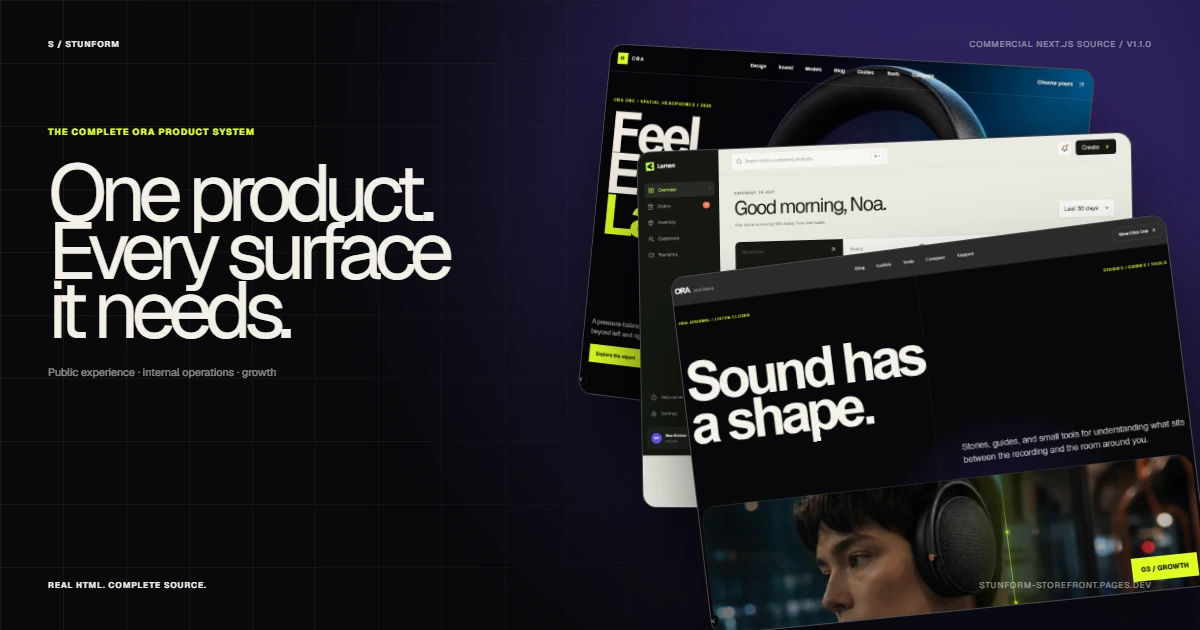
A practical recommendation by team shape
A solo technical founder with an established brand system will often get more leverage from infrastructure and accessible primitives than from a strongly art-directed template. A product designer who can code but needs credible operational depth may benefit more from a connected surface. An agency should optimize for the gap between the template and the client’s actual deliverables, because every unsupported route becomes unplanned margin loss.
Do not buy the largest bundle by default. Buy the smallest foundation that removes your expensive uncertainty. If your uncertainty is authentication, choose a boilerplate. If it is component behavior, choose primitives. If it is how a memorable product should move across public, internal, and growth contexts, inspect a design system such as ORA—and reject it if its visual premise fights your product.
The final test is simple: after viewing the live demo and reading the license, can you list the remaining work without guessing? A trustworthy template makes the boundary visible. The best template is the one whose boundary matches your team.